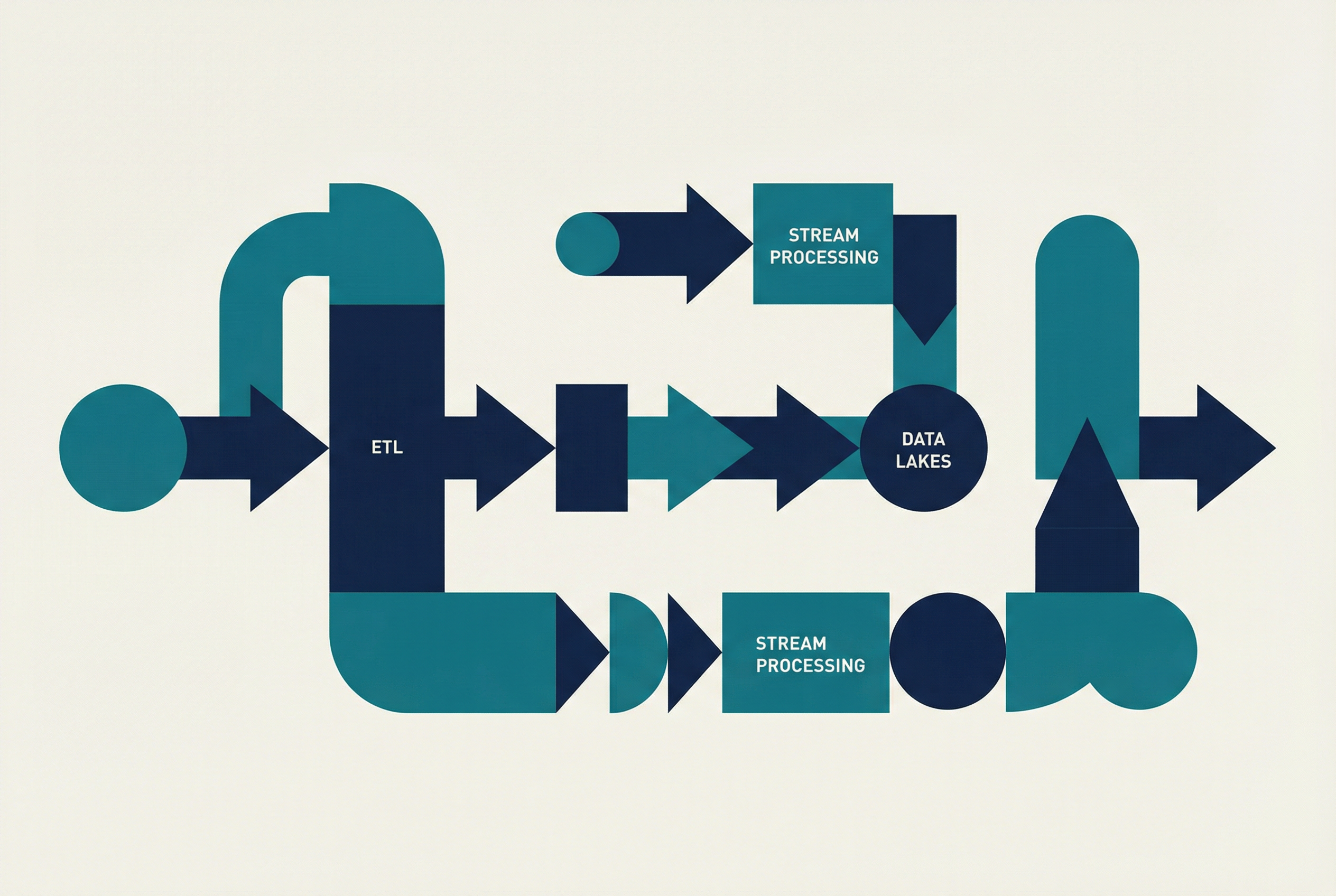

Building Data Pipelines That Don't Break at 3 AM
A practical guide to pipeline reliability, idempotency, and the monitoring patterns that will save your on-call rotation.
The dirty secret of data engineering is that most pipelines are fragile. They work fine in development, pass QA, and then fail silently in production at the worst possible moment — usually when a business-critical report is due, or when a downstream ML model is making real-time decisions. The failure is rarely dramatic. It is usually a missing null check, an upstream schema change that nobody communicated, or a timeout that only triggers under production load.
The Three Properties of a Reliable Pipeline
- —Idempotency: Running the pipeline twice should produce the same result as running it once. This is the single most important property for safe retries and backfills.
- —Observability: You should know a pipeline failed before your stakeholders do. Alerting, logging, and data quality checks are not optional.
- —Graceful degradation: When upstream data is late or malformed, the pipeline should fail loudly and cleanly — not silently produce wrong results.
Idempotency in Practice
Idempotency sounds abstract but it has a concrete implementation pattern: use MERGE (upsert) instead of INSERT, partition your writes by a stable key, and always include a pipeline run timestamp in your audit columns. If you are writing to a data warehouse, use a staging table pattern — write to a temp table first, validate, then swap.
"If you cannot safely re-run your pipeline from any point in time, you do not have a pipeline. You have a prayer."
Datum Daily
Monitoring That Actually Works
Most pipeline monitoring is reactive — you find out something broke when a user complains. Proactive monitoring means checking data quality at every stage: row counts, null rates, value distributions, and freshness timestamps. Tools like Great Expectations, dbt tests, and Monte Carlo make this tractable. The goal is to catch anomalies before they reach the consumption layer.
Discussion
No comments yet. Be the first to start the discussion.